

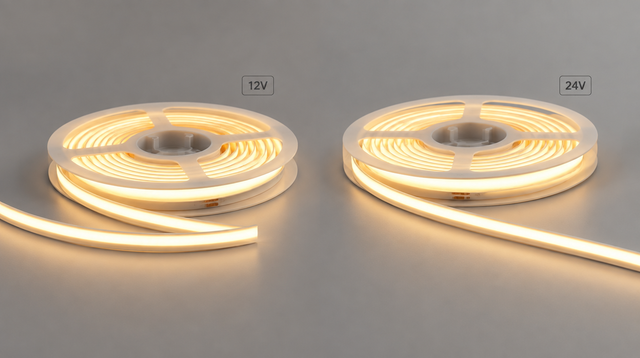
If you've compared LED strips recently, you've likely noticed most are now labelled either 12V or 24V. A few years ago, 12V was the default almost everywhere. Today, 24V has quietly become the most common choice for home installations — and there's a solid technical reason behind that shift.
The Basic Difference
The voltage rating refers to how much electrical power the strip needs to run, which in turn determines the type of driver (transformer) required to power it. A 12V strip needs a 12V driver; a 24V strip needs a 24V driver. They aren't interchangeable — using the wrong driver voltage on a strip will either damage it or stop it from working at the correct brightness.
Voltage Drop: The Real Reason It Matters
The core difference between the two comes down to something called voltage drop. As electricity travels along a strip, some voltage is lost to resistance in the copper traces — and the lower the voltage to begin with, the more noticeable that loss becomes relative to the total. In practice, this shows up as a strip that looks bright near the power source and gradually dims toward the far end.
Because 24V strips start from a higher voltage, the same amount of drop has a much smaller relative effect, so the strip stays visibly in brightness over a much longer run. A 12V strip run too far will show this unevenness far sooner.
How Far Can Each One Go
As a rough guide, 12V strips are best suited to shorter to medium runs — generally up to around 5 metres from a single power point before dimming becomes noticeable. 24V strips can comfortably run considerably further from one power point while staying even.
Current Draw and Wiring
Voltage and current are linked: for the same total wattage, a higher voltage strip draws less current. Take a strip rated at 60W as an example:
At 12V, that works out to 60W ÷ 12V = 5A (5000mA) of current.
At 24V, the same 60W works out to 60W ÷ 24V = 2.5A (2500mA) — exactly half.
That's the core of it: doubling the voltage halves the current (A) needed to deliver the same amount of power.
Lower current means the whole system runs cooler than the higher current option, and in turn reduce degradation in the led chip
Why 24V Has Become the Default for Home Renovation
For most renovation-scale lighting — cove lighting, long cabinet runs, ceiling perimeters, or anything spanning a full room — the combination of lower voltage drop, longer usable run length, and reduced wiring costs makes 24V the more practical option. Worth noting: the strip itself is typically priced the same for a 12V and 24V version of the same spec (same LED density, same CRI, same length), so there's generally no cost penalty to choosing 24V on the strip alone — the savings and performance gains come from the wiring and how far the run can stretch before needing another power point.
This is why most LED strip suppliers now stock 24V as their standard offering, with 12V increasingly positioned as the option for shorter runs or specialty setups rather than the default.
The Takeaway
The choice between 12V and 24V isn't just a technical spec to skim past — it directly affects whether a long strip run stays evenly bright from end to end. For anything beyond a short decorative accent, 24V is generally the safer and more future-proof choice, which is exactly why it's overtaken 12V as the standard for most home lighting projects today.
0 Comments
There are no comments for this article. Be the first one to leave a message!