

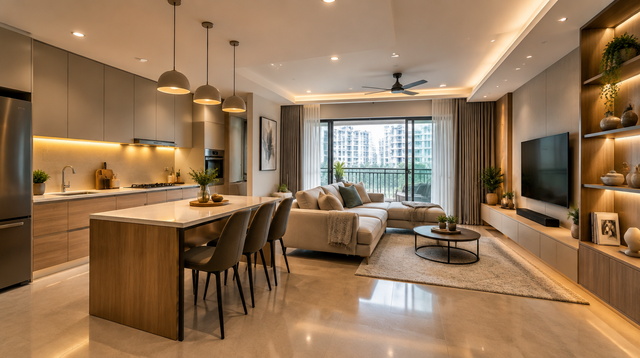

If a room ever feels "off" even though the lights are technically working — too flat, too harsh, or strangely gloomy in places — the issue is often not the lights themselves but the lack of lighting layers. This is one of the most overlooked ideas in home lighting, yet it's the single biggest factor separating a room that feels professionally designed from one that feels like an afterthought.
The Problem With a Single Light Source
Years ago, most homes relied on one central ceiling light (or a single row of downlights) to do everything — light the whole room, help with tasks, and set the mood. The result is usually a flat, evenly-lit space with no depth: everything is visible, but nothing feels particularly comfortable or intentional. Shadows fall in odd places, surfaces look one-dimensional, and the room can feel clinical rather than lived-in.
Lighting layers solve this by splitting the job of "lighting a room" into three distinct types of light that work together rather than one light trying to do everything at once.
Layer 1: Ambient Lighting
Ambient light is the general, overall illumination of a space — think of it as the base layer that lets you move around and see comfortably. This usually comes from ceiling-mounted fixtures, recessed downlights, or larger overhead fittings. On its own, ambient lighting is functional but flat — it's the layer everyone has, but rarely the layer that makes a room memorable.
Layer 2: Task Lighting
Task lighting is focused, functional light aimed at wherever a specific activity happens — reading in bed, chopping vegetables at a kitchen counter, applying makeup at a vanity, or working at a desk. This layer is brighter and more directional than ambient light, because its job is purely practical: helping you see clearly enough to do something specific without straining your eyes.
Common examples include under-cabinet kitchen lighting, desk lamps, reading lights beside a bed, and vanity mirror lighting.
Layer 3: Accent Lighting
Accent lighting is the layer most rooms skip entirely, and it's usually the one that adds the most character. Its purpose is to draw attention to something specific — a piece of art, a textured feature wall, a bookshelf, a plant, or a piece of furniture such as a coffee table — rather than to light the room generally. This is typically achieved with narrow-beam spotlights, track lights, wall lights, wall washers, or LED strip lighting tucked into recesses or behind furniture.
Accent lighting is what creates a sense of depth and dimension in a room. Without it, a space can look correctly lit but visually flat — everything at the same brightness, with nothing for the eye to settle on.
Why Layering Matters More Than People Expect
The real value of layering isn't just aesthetic — it's flexibility. A well-layered room lets you adjust the mood and function of the same space throughout the day: bright ambient and task lighting for cleaning or working during the day, dimmed ambient with accent lighting in the evening for a relaxed atmosphere, and focused task lighting only where and when it's actually needed.
Layering also works across different heights and brightness levels. Ceiling lights, wall lights at eye level and strips tucked low into carpentry each draw the eye to a different part of the room, which is what gives a space its sense of depth and texture.
This matters even more in smaller homes, where a single room often has to serve multiple purposes — a living room that doubles as a workspace, or a bedroom with a reading nook. Layering allows the same physical space to feel appropriate for very different activities, just by changing which layer is switched on.
Why This Needs to Be Planned Early
The tricky part about lighting layers is that they're much harder — and more expensive — to add after renovation work is done, especially in homes with false ceilings, since wiring and recesses for downlights, accent strips, or wall washers usually need to be planned before the ceiling is closed up. This is why lighting layout is worth thinking through early in a renovation, rather than treating it as a final decision made after everything else is already built.
The Takeaway
A room lit with all three layers — ambient, task, and accent — almost always feels more considered and comfortable than one relying on a single light source, even if the total number of light points is similar. It's less about how much light a room has, and more about how thoughtfully that light is distributed across different jobs.
0 Comments
There are no comments for this article. Be the first one to leave a message!