

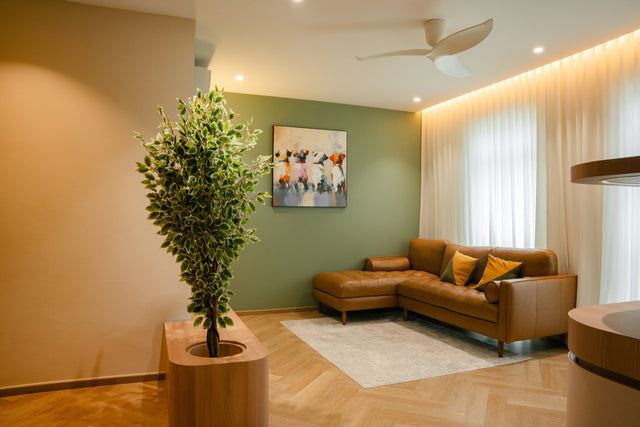
If you are renovating an HDB flat or condo with a false ceiling, most of your ceiling lights will come from two product ranges: the recessed downlight and the recessed spotlight. Both sit flush in the false ceiling and keep the ceiling line clean, but they do very different jobs. This guide explains how the two compare, and how to choose the right one for each room before you place your order.
Recessed Downlight vs Recessed Spotlight: What Is the Difference
"Recessed" means the fitting sits flush with the ceiling. The body of the light is hidden above a hole cut into the false ceiling board, so only the trim ring is visible. In Singapore homes, recessed fittings are used with gypsum board false ceilings, because a concrete slab cannot be cut to fit them.
Within that, there are two distinct product ranges:
Recessed downlight. A fixed fitting, typically an LED light downlight with a built-in LED module, that throws a wide, even spread of light straight down. It is the workhorse for general lighting in living rooms, bedrooms, corridors and kitchens.
Recessed spotlight. A fitting with a narrower, more focused beam, often with an adjustable head that can be tilted. It is used for accent lighting, such as highlighting artwork, feature walls, shelving or a dining table.
|
Recessed Downlight |
Recessed Spotlight |
|
|---|---|---|
|
Main purpose |
General, everyday lighting |
Accent and feature lighting |
|
Beam |
Wide, even spread |
Narrower, focused pool of light |
|
Adjustability |
Usually fixed, pointing straight down |
Fixed and Tiltable, to aim at a feature as a accent light |
|
Typical rooms |
Living room, bedrooms, corridor, kitchen, bathrooms, study area |
Living room, bedrooms, |
|
Ceiling type |
False ceiling |
False ceiling |
Most well-lit homes use both: recessed downlights for the base layer of light for diffused lighting, and recessed spotlights to add depth and draw the eye to specific features.
False Ceiling or Concrete Ceiling: Check Your Ceiling First
Before comparing models, confirm whether each room actually has a false ceiling. BTO flats by default will have concrete ceilings. you will need contractors to build the false ceiling for you to enable to install recessed lamps.
For concrete ceiling, you will need a surface-mounted fitting instead, such as a cylinder-shaped surface-mounted downlight or one of the options in our ceiling light range. Our guide [LINK TO: Ceiling Lights Singapore: A Room-by-Room Guide for Bedrooms, Kitchens and Living Rooms] covers the surface-mounted side of this decision in more detail.
How to Choose Between a Recessed Downlight and a Recessed Spotlight
Start With What the Light Needs to Do
Ask yourself: do you want light spread evenly across the whole room, or do you want to control where it falls?
Recessed downlights work well if you want the whole space lit evenly, with no dark spots.
Recessed spotlights, on the other hand, can also be used as general lighting when you want more control. Because their beam is narrower and can often be angled, you can keep light away from areas you'd rather keep soft, such as the sofa where you relax in the evening.
Recessed spotlights are also the usual choice for accent lighting. If there's a painting, a textured wall, a TV console or a display shelf you want to highlight, a spotlight is what makes it stand out. In many living and dining areas, the best answer is a mix of both.
Beam Angle
The beam angle tells you how much area a light will cover.
- 15° to 25°: a very narrow beam that lights up a small area, such as a sculpture or display on a pedestal.
- 35°: for years the most common angle for spotlights used as general lighting.
- 50°: increasingly the preferred choice today. It covers a much wider area with fewer dark spots, while still giving you the cosy ambience and sense of layering that diffused lighting can't.
- 100° and above: typical of diffused downlights, which give flat, even light with no sharp shadows. This is why they're widely used in kitchens and study areas, where you need clear light for tasks.
Keep in mind that ceiling height matters too: the same beam angle will spread over a larger area from a higher ceiling.
Cut-Out Size
The cut-out is the diameter of the hole in the ceiling board. It's one detail your contractor needs early, because the holes are cut before the lights arrive. Common cut-out sizes are 75mm and 85mm, both of which give a neat, compact look.
Keeping the same cut-out across your downlights and spotlights makes the ceiling look consistent and gives you the flexibility to swap fittings later. If you're torn between two sizes, lean towards the smaller one. A hole can always be enlarged later if you switch to a bigger fitting, but a hole that's too big can't be made smaller without patching the ceiling.
Lights are also getting smaller, with options now at 55mm, 45mm and even 35mm. While smaller fittings are generally considered better looking, they come with compromises, so it's worth checking they suit your needs. Smaller lights tend to be less bright and often come with a narrower beam, so you may need more of them to light the same area. For this reason, a 35mm fitting may not be enough for general lighting and is better suited to accent lighting.
Round Downlights or Square
Round downlights remain the most popular choice in Singapore homes because they blend into almost any interior style and are easy to align. Square fittings suit more angular, contemporary designs, but they must be lined up precisely with walls and cabinetry, or small misalignments become obvious.
Brightness, Wattage and Colour Temperature
With LED, look at lumens rather than watts, because lumens measure the actual light output. According to the U.S. Department of Energy, LEDs use up to 90% less energy and last up to 25 times longer than traditional incandescent bulbs, which is why they are now the default for home downlighting. For colour temperature, 3000K feels warm and relaxing, 4000K is a neutral white many Singapore households prefer for living areas, and 6500K is a crisp daylight tone. Where downlights and spotlights share a room, keep them at the same colour temperature. Our article on downlight Singapore colour temperatures explains how to choose between them.
GU10 Bulb or Integrated LED Module
Some recessed fittings take a replaceable GU10 bulb, while others use a fixed LED module with an external driver. GU10 fittings make future bulb changes easy; LED modules typically offer better colour quality, longer longevity, and a slimmer profile. We compare both in detail in recessed spotlight: GU10 or LED module.
IP Rating for Bathrooms
Bathrooms need a fitting with protection against moisture. The IP (Ingress Protection) code, defined by the International Electrotechnical Commission, uses two digits: the first for protection against solids and the second for protection against water. An IP44 rating means the fitting is protected against splashing water, which is a sensible minimum for most bathroom ceilings.
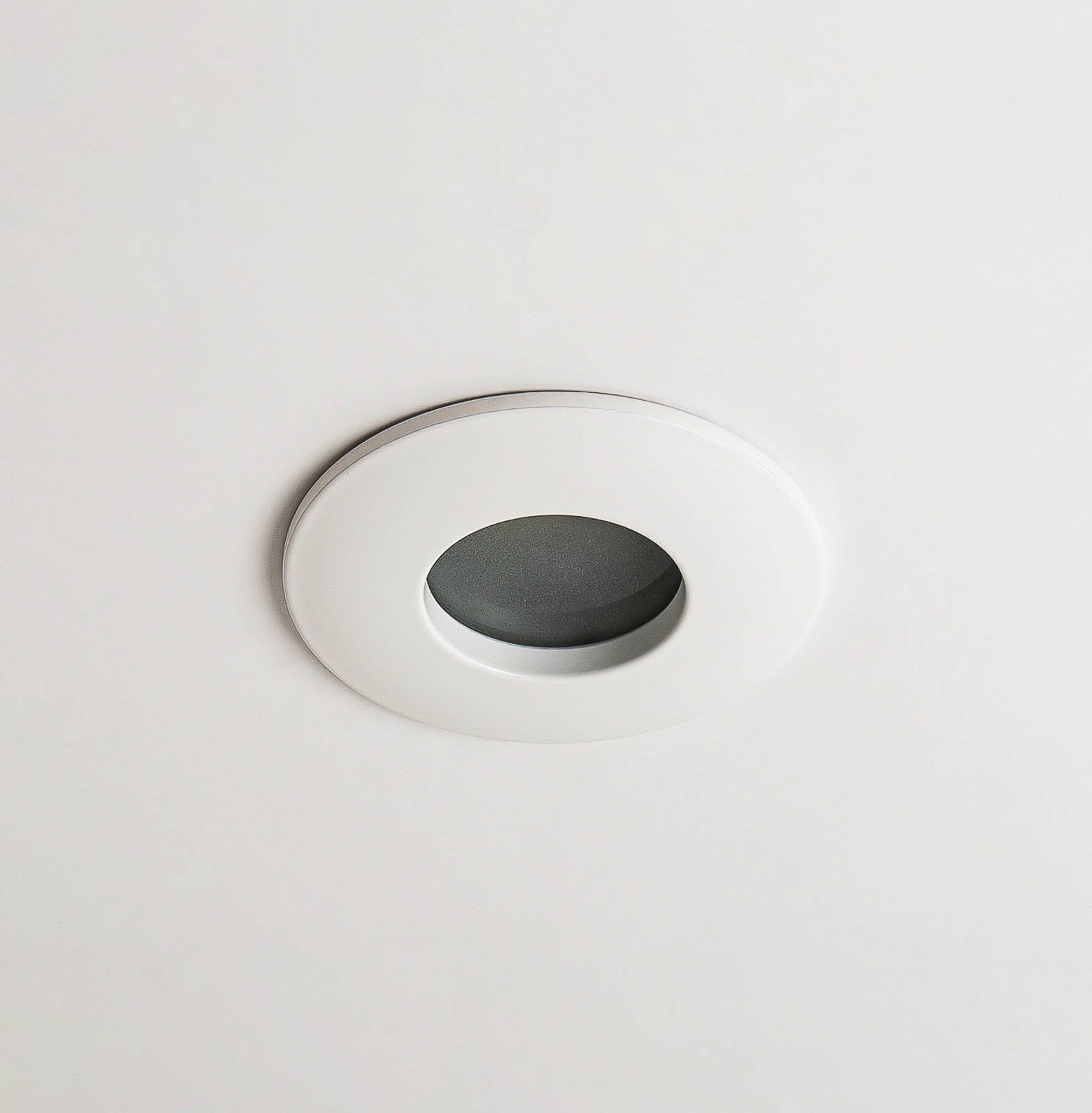
The Canopy Splash is an IP44-rated recessed spotlight designed for bathroom use. It uses an 85mm cut-out and can be fitted with either a Philips GU10 bulb or an LED module, so it can sit alongside the rest of your downlights without needing a different hole size.

https://northstarlighting.sg/cdn/shop/files/Northstar-Lighting-CanopySplash-3.jpg
How Many Downlights and Spotlights Does Each Room Need
There is no single formula, but a common starting point for general lighting is to space fixtures roughly 1.5 to 2 metres apart, and around 0.4 to 0.6 metres from walls. As a rough guide for typical HDB flats (condos are similar):
- Bedroom: around 4 lights, or fewer if you add cove or bedside lighting.
- Living room: 6 to 8 lights, depending largely on the size of the space.
- Corridor: one light every 1.2 to 1.5 metres.
- Kitchen: often 3 lights for even coverage over worktops, plus under-cabinet lighting.
- Bathroom: 2 to 3 recessed downlights or spotlights.
These are very rough figures, based on BTO flats ranging from 2-room to 5-room. For a more accurate estimate, it's still best to speak to us with your floor plan and layout.
A Quick Buying Checklist for Renovation Orders
Before you order, confirm which rooms have false ceilings, which points need general lighting (recessed downlights) and which need accent lighting (recessed spotlights), the cut-out size your contractor will use, and one consistent colour temperature per zone. Also check that any wet areas use IP-rated fittings. Keep in mind that downlights and spotlights should be wired and installed by a licensed electrical worker, as advised by the Energy Market Authority. If you are buying for a whole flat, [LINK TO: BTO Lighting Package Guide: How to Plan and Budget Lighting for Your New HDB Home] explains how to plan the full order in one go.
Frequently Asked Questions
Can I use recessed spotlights for general lighting?
Yes, and many homeowners now do. A spotlight with a wider beam, such as 50°, can light a room well while giving you more control over where the light falls. For example, you can keep bright light off the sofa while still lighting the rest of the living room. If you prefer a room lit completely evenly with no dark spots, recessed downlights are the simpler choice. Many homes use a mix of both.
Can I mix recessed downlights and recessed spotlights in the same room?
Yes, and many living and dining areas benefit from it. Use downlights for the base layer and spotlights for features, and keep the cut-out size and colour temperature consistent so the ceiling looks tidy.
Can I install recessed downlights or spotlights on a concrete ceiling?
Cannot. Recessed fittings need a false ceiling to sit in. For concrete ceilings, choose a surface-mounted fitting, such as a cylinder-shaped surface-mounted downlight, a ceiling light or a track light.
What cut-out size is most common for home downlights?
Many residential downlights and spotlights use a cut-out of around 75mm, but sizes vary by model.
Choosing between a recessed downlight and a recessed spotlight comes down to what each light needs to do: downlights for even, general lighting, and spotlights for focused accents. Once that is clear, match the cut-out size, beam angle, colour temperature and moisture protection to each room. At Northstar Lighting, you can compare downlight and spotlight options at our showroom, bring along your floor plan for a 1-to-1 consultation, and receive an obligation-free quotation for your whole home. Explore our recessed downlight and spotlight range online or visit us to see the light output for yourself.
References
1. U.S. Department of Energy. (2026). Lighting Choices to Save You Money. Energy Saver. https://www.energy.gov/energysaver/lighting-choices-save-you-money
2. International Electrotechnical Commission. (2024). IP Ratings. IEC. https://www.iec.ch/ip-ratings
3. Energy Market Authority. (2026). Who Should I Engage To Assist With My Electrical Works? EMA. https://ema.gov.sg/resources/faqs/electricity/general-electricity-works/who-should-i-engage-to-assist-with-my-electrical-works-eg-rewiring-of-my-house
0 Comments
There are no comments for this article. Be the first one to leave a message!